
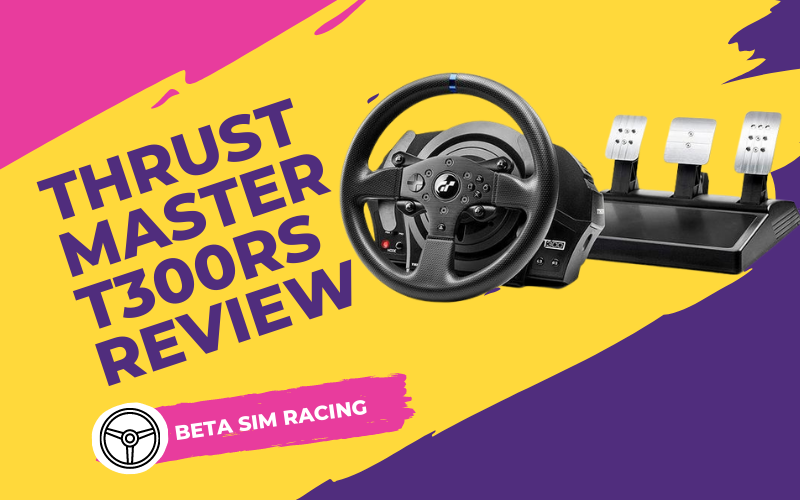
The Thrustmaster T300RS holds a significant position in the mid-range sim racing market, offering a notable step-up from entry-level gear-driven wheels. Officially licensed for PlayStation consoles and also featuring PC compatibility, it is engineered to deliver a more authentic and immersive driving experience. This analysis provides a detailed examination of its technical specifications, build quality, performance characteristics, and place within the broader sim racing ecosystem.
For those evaluating options in this category, understanding how the T300RS measures up against its contemporaries is crucial. While it represents a significant advancement over gear-driven models like the Logitech G920, it also faces competition from other belt-driven and entry-level direct-drive wheels.
Thrustmaster T300RS & Key Competitors: A Detailed Comparison
The following table offers a direct comparison of the Thrustmaster T300RS against other popular racing wheels in and around its class, providing key data points for an informed decision.
| Feature | Thrustmaster T300RS | Logitech G29/G920 | Thrustmaster T248 | Fanatec CSL DD (5 Nm) |
| Drive System | Dual-Belt Drive | Gear Drive | Hybrid (Gear & Belt) | Direct Drive |
| Max Rotation | 1080° | 900° | 900° | 2520° (Adjustable) |
| Force Feedback Motor | Industrial-class Brushless | Brushed Motor | Brushed Motor | Custom Servo Motor |
| Platform Compatibility | PS5, PS4, PS3, PC | PS5/PS4/PC (G29), Xbox/PC (G920) | PS5, PS4, PC | PC, Xbox Ready (with compatible wheel) |
| Pedals Included | 2-pedal set (T300RS) | 3-pedal set | 3-pedal set (T3PM) | Not Included (Sold Separately) |
| Clutch Pedal | No (Standard) / Yes (GT Edition) | Yes | Yes | Available with pedal sets |
| Wheel Rim Material | Reinforced Rubber | Hand-stitched Leather | Leather-wrapped foam | Varies by Wheel (Sold Separately) |
| Quick Release System | Yes (Thrustmaster System) | No (Hard-mounted) | No (Hard-mounted) | Yes (QR1 Lite / QR2) |
| Base Unit Cooling | Active (Internal Fan) | Passive | Passive | Passive (Aluminum Heatsink) |
| Official Licensing | PlayStation (Sony) | PlayStation or Xbox | PlayStation | None (Platform specific compatibility) |
Core Technical Specifications of the Thrustmaster T300RS
The performance of a racing wheel is fundamentally determined by its internal mechanics and external construction. The T300RS is built around a technology that aims to bridge the gap between less detailed gear systems and high-end direct-drive units.
Force Feedback and Motor Technology
At the heart of the T300RS is a dual-belt, friction-free mechanism powered by an industrial-class brushless servomotor. This design choice is central to its performance characteristics.
- Brushless Servomotor: Unlike the brushed motors found in many entry-level wheels, the brushless design offers more efficient, responsive, and durable performance. It generates less internal friction, leading to smoother force delivery and reduced wear over its lifespan. An internal fan activates to manage motor temperatures during prolonged use, typically after 15-20 minutes of intense force feedback activity.
- Dual-Belt System: This system connects the motor to the steering shaft, resulting in force feedback that is significantly smoother and less “notchy” than the feel produced by gear-driven systems. It allows for a more nuanced translation of in-game physics, such as road texture, tire slip, and weight transfer.
- H.E.A.R.T. Technology: The wheel utilizes Thrustmaster’s HallEffect AccuRate Technology (H.E.A.R.T), which incorporates a contactless magnetic sensor. This provides 16-bit resolution on the steering axis, translating to 65,536 distinct values. This high precision ensures that even the smallest steering inputs are accurately registered.
Design and Build Quality
The T300RS features a mixed-material construction, balancing durability in key areas with cost-effective choices elsewhere. A proper sim racing setup guide can help maximize its potential.
Wheel and Base Unit Analysis
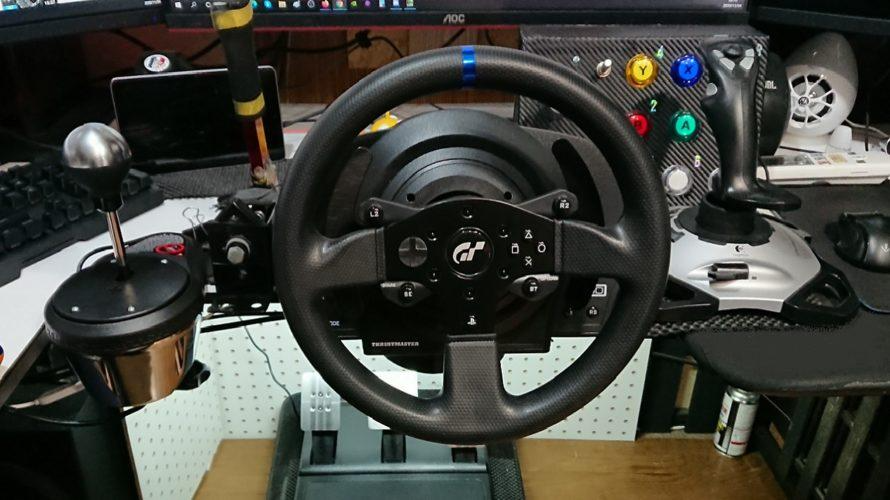
The base unit is substantial and houses the motor and electronics. The exterior is primarily high-quality plastic, but the internal mechanism is metal. The included 11-inch (28 cm) wheel rim is coated in reinforced rubber for grip and features brushed metal spokes. Large, 13 cm sequential paddle shifters are mounted to the wheel and are crafted from metal, delivering a tactile and audible click with each shift.
A key feature of the T300RS is the full integration of PlayStation controls. It includes the PS, SHARE, and OPTIONS buttons, alongside the full D-pad and face buttons found on a DualShock controller, allowing for complete system navigation without needing a separate gamepad.
Pedal Set Examination
The standard T300RS package includes a two-pedal set (throttle and brake) with metal pedal faces and a plastic base. The brake pedal is engineered to offer progressive resistance, simulating the feel of a real-world braking system more effectively than a simple linear spring.
The pedals can be adjusted for both spacing and height to accommodate user preference. However, the plastic base is lightweight and lacks significant grip, which can lead to it sliding on smooth floors during intense gameplay. For a stable experience, mounting it to a best racing wheel stand or a full sim racing cockpit is advisable.
Setup and Platform Compatibility
Ease of setup and broad compatibility are essential for a user-friendly experience across different platforms and sim racing games.
Initial Setup and Calibration Process
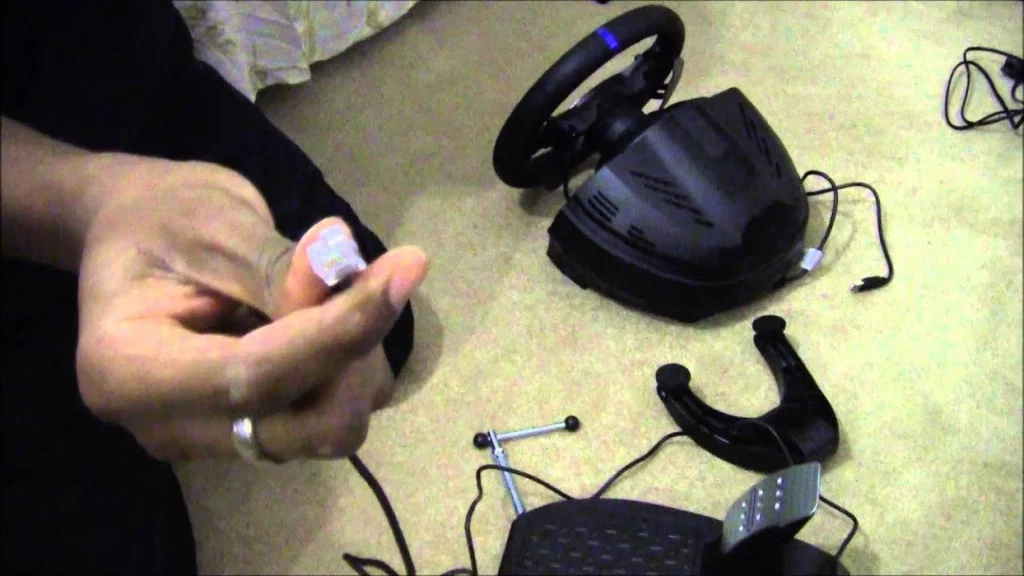
Setting up the T300RS is straightforward. It involves attaching the wheel rim to the base via the Thrustmaster Quick Release system and securing the base to a desk or wheel stand using the included clamp. Once connected to power and the console/PC, the wheel performs an automatic calibration cycle, rotating fully to each side before centering itself. This process ensures the sensors are correctly aligned before use. Further adjustments, like pedal sensitivity, can be made using tools like the TM Sim Pedals Calibration Tool.
Compatibility with PlayStation and PC
The T300RS boasts official licensing from Sony, ensuring seamless compatibility with PlayStation 5 and PlayStation 4. For users who also enjoy older titles, a physical switch on the base toggles compatibility for PlayStation 3.
- PlayStation 5 & 4: Full “plug-and-play” functionality. The wheel is automatically recognized in supported PS4 steering wheel games and PS5 titles.
- PC Compatibility: The T300RS is fully compatible with PC. Users can download dedicated drivers from the Thrustmaster support website, which allow for firmware updates and advanced settings customization, such as adjusting force feedback strength, rotation angle, and damper effects.
Note: This wheel is not compatible with Xbox consoles. For a multi-platform solution that includes Xbox, one would need to consider a different model, such as the Thrustmaster TX or a wheel from a competitor like the Logitech G920.
Performance in Sim Racing Titles
The ultimate measure of a racing wheel is its in-game performance. The T300RS’s brushless, dual-belt system provides a distinct feel that enhances immersion in racing simulators like Assetto Corsa Competizione and Gran Turismo 7.
Force Feedback Immersion and Detail
The force feedback is the standout feature of the T300RS. It communicates the car’s behavior with clarity and strength. Users can feel the texture of different road surfaces, the loss of traction as tires begin to slide, and the load on the steering through high-speed corners. Compared to gear-driven wheels, which can feel clunky or grindy, the T300RS delivers forces smoothly, allowing the driver to react more instinctively to the vehicle’s dynamics. For those seeking even greater immersion, combining the wheel with a haptic system like the Buttkicker Gamer Plus can elevate the experience further.
Handling and Responsiveness
The wheel’s precision, derived from its 16-bit magnetic sensor, ensures that steering inputs are translated with accuracy. This allows for precise car placement on the track, which is critical for consistent lap times. The motor is powerful enough to wrestle with the user during sharp direction changes or when catching a slide, providing a dynamic and engaging driving experience that is impossible to replicate with a standard controller.
The Thrustmaster Ecosystem and Upgradability
One of the most significant advantages of the T300RS is its position within the Thrustmaster ecosystem. The base unit is designed to be a long-term investment that can be upgraded and customized over time.
Detachable Wheels and Pedal Options
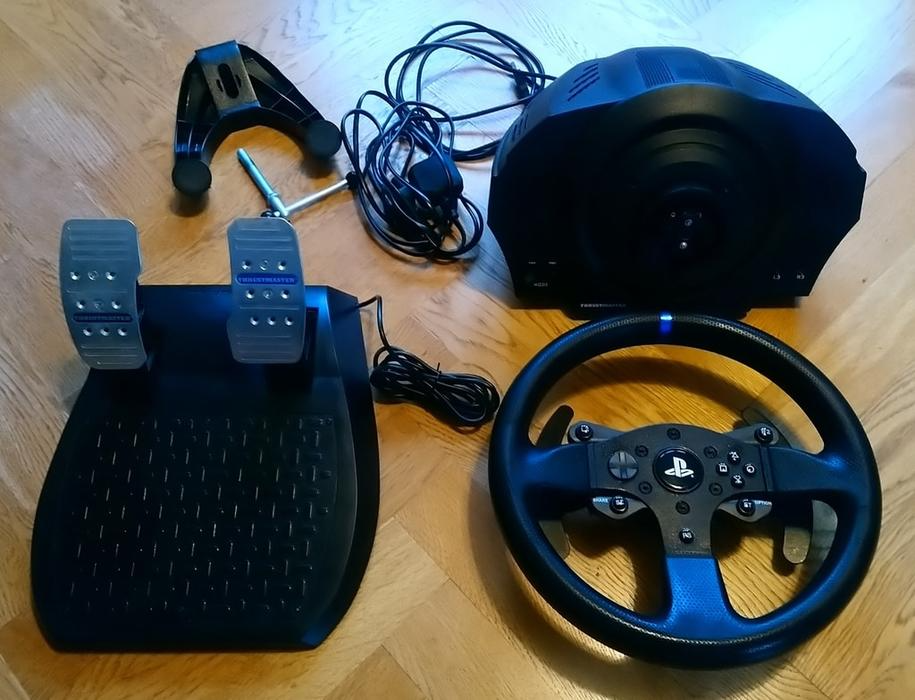
The Thrustmaster Quick Release system allows the stock wheel rim to be easily swapped for a variety of optional add-ons. This enables users to match their wheel to their preferred style of racing. Available options include:
- Formula 1 Style Rims: Such as the popular Thrustmaster Ferrari F1 wheel, ideal for open-wheel racing.
- Rally and GT Rims: Different sizes and materials are available to suit various motorsport disciplines.
Similarly, the included pedal set can be replaced with more advanced options, like the three-pedal Thrustmaster T3PA-PRO Pedals (which includes a clutch) or the high-end T-LCM load-cell pedals for a more realistic braking feel.
An Objective Look: Strengths and Limitations
Every piece of hardware has its advantages and disadvantages based on its design and market position.
Key Strengths
- Smooth and Powerful Force Feedback: The brushless dual-belt system is a significant improvement over gear-driven competitors.
- High-Precision Steering: 16-bit resolution ensures accurate input registration.
- Excellent Platform Compatibility: Officially licensed for PlayStation 5/4 and fully compatible with PC.
- Strong Ecosystem: The detachable wheel and upgradable pedals offer a clear path for future enhancements.
- Durable Internal Mechanics: The brushless motor design suggests a longer operational lifespan with consistent performance.
Areas for Consideration
- Standard Pedal Set: The included two-pedal set’s plastic base and lack of a clutch are a letdown for the price point. The T300RS GT Edition, which includes the T3PA three-pedal set, is a more complete package.
- Active Cooling Noise: The internal fan, while necessary for performance, can become audible during long sessions.
- No Xbox Compatibility: Users on the Xbox platform will need to look at other models.
Frequently Asked Questions (FAQ)
What is the main difference between the Thrustmaster T300RS and the T300RS GT Edition?
The primary difference is the pedal set. The standard T300RS comes with a two-pedal (throttle and brake) set with a plastic base. The T300RS GT Edition includes the superior T3PA-GT three-pedal set, which adds a clutch pedal and features a more robust build.
Does the Thrustmaster T300RS work on PlayStation 5?
Yes, the T300RS is officially licensed and fully compatible with the PlayStation 5, working with all PS5 and PS4 racing titles that support wheel peripherals.
Is the Thrustmaster T300RS a direct-drive wheel?
No, the T300RS is not a direct-drive wheel. It uses a dual-belt system to transmit force from the motor to the wheel. This is considered a step above gear-driven wheels but is less powerful and detailed than a true direct-drive wheel like the Fanatec CSL DD.
How does the T300RS compare to the Logitech G29?
The T300RS is generally considered a higher-tier product than the Logitech G29. Its dual-belt force feedback system is smoother, quieter, and more detailed than the G29’s gear-driven mechanism. However, the G29 includes a three-pedal set as standard.
Can the pedals on the T300RS be upgraded?
Yes. The T300RS base is compatible with other Thrustmaster pedal sets, including the T3PA, T3PA-PRO, and the high-end T-LCM load-cell pedals, allowing for a significant braking performance upgrade. You can find information on how to calibrate Thrustmaster pedals for optimal performance.

With a background in mechanical engineering and over a decade in competitive sim racing, Kenji serves as our lead Sim Racing Physics & Hardware Analyst. He deconstructs complex topics like force feedback and suspension geometry, helping readers understand the crucial engineering behind a perfect lap time. Kenji’s passion is to translate real-world motorsport principles into actionable knowledge for the sim racing community.